

Jane Goodall’s legacy celebrated as new portrait unveiled at Science Museum a year after her death
A vibrant portrait of pioneering scientist Dr Jane Goodall has been unveiled at London’s Science Museum to mark the first anniversary of her death.
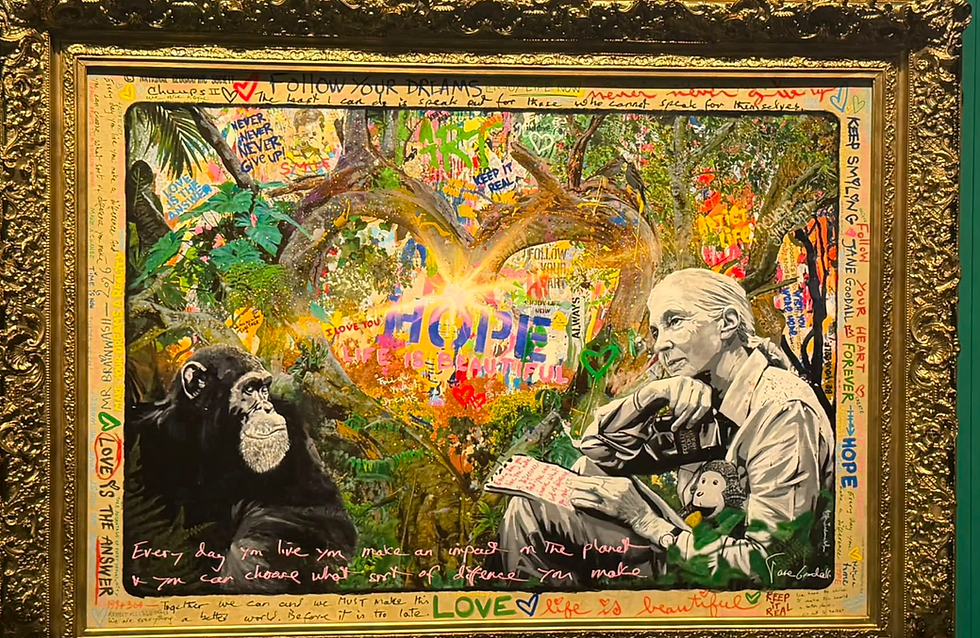
The artwork, titled ‘Light of Life Is Forever’ and created by artist Mr Brainwash, has been donated by the Jane Goodall Institute and placed on permanent display, where visitors can see it for free.
Friends and fellow animal welfare campaigners gathered to remember the conservationist, whose groundbreaking research into chimpanzees transformed our understanding of animals and humanity’s place in the natural world.
Goodall died aged 91 on 1 October 2025 while in Los Angeles on a speaking tour. Her work inspired generations of scientists, conservationists and young people around the globe.
Among those attending the unveiling were longtime animal welfare campaigner Dr Jane Washington-Evans, who knew Goodall, and actor Peter Egan, best known for his roles in Downton Abbey and Ever Decreasing Circles.

The pair as part of the Campaign to Ban Trophy Hunting team and were thanked during the event for their work for wildlife alongside parliamentary colleagues.
Dr Washington-Evans said: “I was deeply moved to be at the unveiling of this beautiful portrait of Jane. It was especially poignant to see her remembered in a place where she can continue to inspire so many people.
“It was also a complete surprise to be thanked by Mary for the work Peter Egan, our parliamentary colleagues and the team have been doing for wildlife. After 30 years of campaigning, I am not used to being singled out.
“At first, I thought she was referring to Dr Jane Goodall rather than me, until someone gave me a prod. It was a very special moment on a day devoted to an extraordinary woman.”

Mary Lewis, of the Jane Goodall Institute, who worked closely alongside Goodall for decades, told guests that her presence remained strongly felt.
“I feel her presence constantly,” she said.
“I don’t believe that Jane would have left this planet for the next great adventure, as she called it, unless she felt confident that her global organisation was ready to take over. She has empowered so many of my colleagues to continue this work.”
Lewis described how teams around the world were carrying forward the programmes Goodall created during a career spanning 65 years.
Her legacy continues through community-led conservation, care for rescued chimpanzees and Roots & Shoots, the programme she founded to help young people take action for animals, people and the environment.
“Our collective JGI voices are making the world a better place and changing things for people and the environment on a daily basis,” Lewis said.

“There are many, many exciting developments to come, and I’m really positive about our future.”
Alongside the tributes to Goodall’s scientific achievements, Lewis remembered a friend whose demanding schedule never extinguished her playful spirit.
“She had a terrific sense of humour and never missed the chance for fun,” she said.
Lewis recalled Goodall’s enthusiasm for April Fool’s Day tricks and an appearance when she borrowed clothes, wet her hair and stuffed a pillow down her front before pretending to be a replacement speaker for her own keynote address.
The memories offered a glimpse of the woman behind one of science’s most recognisable figures.
Goodall began studying wild chimpanzees at Gombe in Tanzania in 1960. Her observation that they could make and use tools challenged the prevailing belief that this ability belonged exclusively to humans.
She went on to become a powerful international voice for animal welfare and environmental protection, while encouraging people to recognise that their everyday actions could make a difference.
Find out more at: https://www.janegoodall.org.uk


